The global automotive aftermarket is entering a new phase. As electric vehicles (EVs) become increasingly common, automotive retailers, accessory distributors, and 4x4 modification shops are encountering new opportunities beyond traditional maintenance and replacement parts.
Electric pickups, plug-in hybrid SUVs, and battery-electric passenger vehicles are creating demand for model-specific accessories, from protective floor mats and storage organizers to roof racks, running boards, and pickup bed covers.
For aftermarket businesses, the opportunity is not simply to sell more EV accessories. It is to build profitable, differentiated product portfolios around the practical needs of a growing vehicle population.
This article examines the latest industry data, the commercial potential of 4x4 and interior accessories, and how automotive retailers can enter the EV aftermarket while managing sourcing and inventory risks.
1. The Global EV Market Is Creating a Larger Aftermarket Customer Base
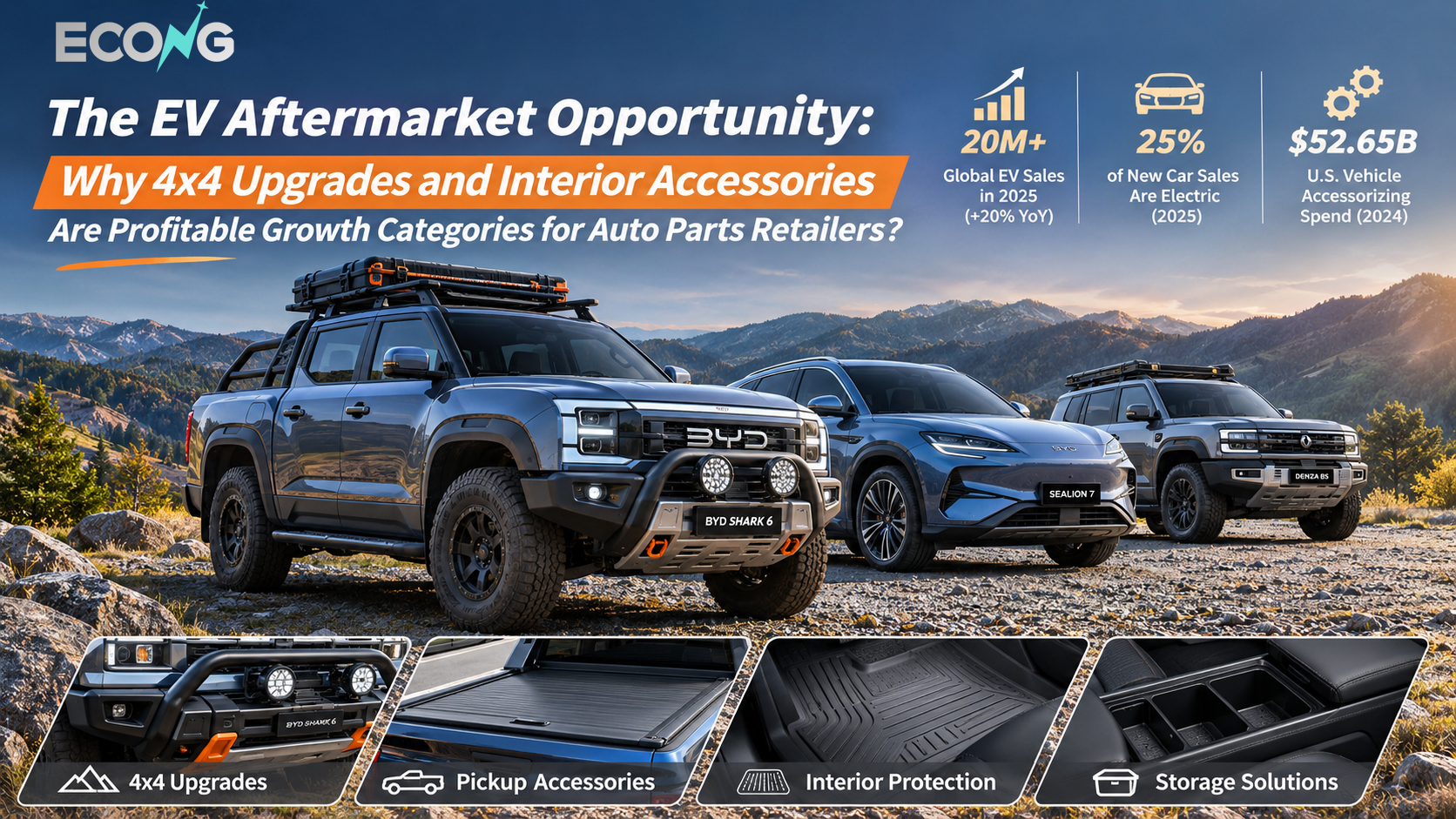
According to the International Energy Agency (IEA), global electric car sales exceeded 20 million units in 2025, increasing by approximately 20% year over year. Electric vehicles represented around 25% of global new-car sales.
The IEA's Global EV Outlook 2026 also reports that electric car sales in Europe grew by more than 30% in 2025, while emerging markets across Asia and Latin America continued to expand.
Importantly, the IEA's electric car figures include both battery-electric vehicles (BEVs) and plug-in hybrid electric vehicles (PHEVs).
For automotive accessory businesses, these developments have several implications:
-
A growing number of EVs on the road increases the potential customer base for vehicle-specific accessories.
-
New electric SUVs and pickups introduce additional fitment requirements.
-
International expansion by Chinese automakers creates opportunities for local accessory distributors.
-
Different driving environments generate demand for protection, storage, comfort, and practical upgrades.
However, higher vehicle sales do not automatically translate into proportional aftermarket accessory sales. Actual demand depends on vehicle ownership patterns, accessory availability, consumer spending, and local market conditions.
Source: International Energy Agency, Global EV Outlook 2026.
2. Why 4x4 and Pickup Accessories Deserve Attention
The pickup accessory market provides an established example of how vehicle owners spend money on customization.
According to the Specialty Equipment Market Association (SEMA), American consumers spent approximately USD 52.65 billion on vehicle accessorizing and modification in 2024.
SEMA's 2025 Market Report also found that pickup trucks accounted for approximately one-third of the U.S. specialty-equipment market, making pickups the leading vehicle segment for aftermarket spending.
These figures cover the broader U.S. vehicle modification market, not the EV-specific accessory market. Nevertheless, they demonstrate the commercial significance of pickup customization.
Electric Pickups Bring New Opportunities
The arrival of electrified pickups such as the BYD Shark 6 provides accessory retailers with additional product opportunities.
Unlike conventional passenger vehicles, pickups are frequently used for multiple purposes, including commuting, outdoor recreation, carrying equipment, and commercial activities.
This creates several accessory categories worth evaluating:
Pickup Bed Accessories
Exterior Protection and Off-Road Accessories
Touring and Utility Accessories
For 4x4 workshops, these products can create both retail and installation revenue opportunities.
However, retailers should verify mounting points, load ratings, vehicle dimensions, electrical compatibility, and applicable local regulations before offering structural or electrically operated modifications.
3. Why Interior Accessories Can Be an Attractive Entry Point
While off-road upgrades can generate substantial individual transactions, interior accessories offer a different commercial advantage: they address everyday vehicle ownership needs.
Floor protection, storage, convenience, and cabin organization are relevant to a broad range of drivers, including customers who have no interest in performance or exterior modifications.
Practical Product Categories
TPE Floor Mats and Cargo Liners
Vehicle-specific floor mats and trunk liners help protect original interior surfaces against dirt, moisture, and everyday wear.
Retailers should evaluate material specifications, fitment accuracy, odor characteristics, cleaning requirements, and local chemical compliance.
Frunk Storage Boxes
Front trunk organizers can improve storage utilization in compatible electric vehicles.
Injection-molded PP storage boxes are one possible product solution, provided they are designed for the correct vehicle configuration and do not obstruct safety systems or required access points.
Center Console and Interior Organizers
Cup holder inserts, armrest storage boxes, and console organizers provide practical upgrades that can be sold individually or as part of accessory bundles.
Dashboard Covers and Sunshades
Dashboard mats and windshield sunshades may appeal to customers in hot climates, particularly where parked vehicles experience prolonged sunlight exposure.
Product selection should account for airbag clearance, visibility, and vehicle-specific dimensions.
Commercial Advantages for Retailers
Interior accessories can be attractive because many products:
-
Require little or no professional installation.
-
Are suitable for online retail and physical stores.
-
Can be grouped into vehicle-specific accessory packages.
-
Offer opportunities for cross-selling.
-
Have relatively straightforward product demonstrations.
These characteristics may reduce selling complexity compared with technically demanding vehicle modifications.
Nevertheless, profit margins are not guaranteed. Freight costs, product quality, local competition, returns, and customer acquisition costs all affect profitability.
4. Which EV Models Should Aftermarket Businesses Prioritize?
The most effective product strategy is not necessarily to offer accessories for every electric vehicle.
Instead, retailers should prioritize models with a meaningful local ownership base, identifiable customer needs, and reliable accessory supply.
BYD Shark 6: Electrified Pickup Accessories
The BYD Shark 6 is a plug-in hybrid pickup that provides opportunities for 4x4 and utility accessory retailers.
Potential product categories include:
-
Tonneau covers and pickup bed protection
-
Front bumper guards and skid plates
-
Roof racks and cargo accessories
-
Running boards and side steps
-
TPE floor mats and dashboard covers
This model is particularly relevant for retailers evaluating electrified pickup accessories in markets where the vehicle is officially sold.
BYD Sealion 6 / Seal U / Song Plus: Practical SUV Accessories
The BYD Sealion 6, Seal U, and Song Plus names are used across different markets and vehicle configurations. Retailers should not assume that every product fits every version.
Potential categories include:
-
Floor mats and trunk liners
-
Window visors and rain guards
-
Interior storage organizers
-
Mud flaps
-
Exterior protection accessories
Vehicle year, powertrain, steering position, and regional specifications should be confirmed before ordering.
BYD Sealion 7: Electric SUV Protection and Storage
For the BYD Sealion 7, accessory retailers can explore:
-
Vehicle-specific floor mats
-
Front trunk storage solutions, where compatible
-
Cargo liners and storage boxes
-
Mud flaps and window visors
-
Interior protective accessories
These categories can support a practical, protection-focused product portfolio.
Denza B5 / Leopard 5 and Denza B8 / Leopard 8
Electrified off-road SUVs offer additional opportunities for specialist 4x4 retailers.
Depending on the vehicle configuration and applicable regulations, relevant accessories may include:
-
Roof platforms and luggage racks
-
Rear ladders and storage panels
-
Protective floor mats and cargo liners
-
Exterior protection components
-
Interior organization accessories
For structural upgrades, retailers should pay particular attention to vehicle load limits, installation requirements, and manufacturer warranty conditions.
5. Where Do Aftermarket Retailers Actually Make Money?
A successful aftermarket business should evaluate total transaction profitability rather than focusing only on product markup.
Consider three potential revenue models.
Model A: Product-Only Retail
A retailer purchases accessories from a wholesale supplier and sells them through an online store or physical location.
This model is suitable for products such as floor mats, organizers, mud flaps, and sunshades.
The main considerations are landed cost, selling price, inventory turnover, shipping expenses, and return rates.
Model B: Product Plus Installation
A 4x4 workshop sells an accessory together with professional installation.
Potential products include roof racks, running boards, protective components, and pickup bed covers.
This approach can generate both product revenue and installation revenue, although labor costs, technical requirements, and warranty responsibilities must be included in the calculation.
Model C: Vehicle-Specific Accessory Packages
Retailers can combine complementary products into packages for particular vehicle models.
For example, a BYD Shark 6 protection package could include:
Bundling can increase average transaction value when customers perceive a clear practical benefit.
However, retailers should measure bundle conversion rates and contribution margins rather than assuming that larger orders are automatically more profitable.
Understanding Real Profitability
A useful starting point is:
Gross Profit = Net Sales Revenue − Cost of Goods Sold
For more practical retail decision-making:
Contribution Profit = Net Sales Revenue − Product Cost − Freight and Duties − Payment Fees − Variable Selling Costs − Expected Returns − Variable Installation Costs
This helps retailers compare product categories more accurately.
A high-ticket off-road accessory may produce greater revenue per order, while a smaller interior accessory may require less installation labor and working capital.
The most attractive category depends on the retailer's actual operating model.
6. Regional Opportunities: Australia, Europe, and Latin America
EV aftermarket opportunities vary considerably by region.
Australia: Pickup Utility and 4x4 Accessories
Australia is a relevant market for evaluating electrified pickup and SUV accessories because it has an established pickup and 4x4 ownership culture.
Retailers can investigate products for vehicles such as the BYD Shark 6, focusing on practical upgrades for utility, outdoor activities, and vehicle protection.
Right-hand-drive compatibility and Australian vehicle modification requirements are essential considerations.
Europe: Model-Specific EV Interior Accessories
Europe's expanding electric vehicle market creates opportunities for retailers supplying protection, convenience, and storage products.
According to the IEA, European electric car sales increased by more than 30% in 2025.
Retailers should evaluate local vehicle registrations, country-specific model availability, and customer demand before selecting inventory.
Products such as floor mats, cargo liners, window visors, and storage organizers may provide an accessible starting point.
Latin America: An Emerging Opportunity
The IEA has identified Latin America as an important emerging EV market, supported partly by increasing availability of competitively priced electric vehicles.
Brazil and other regional markets may offer opportunities for distributors of Chinese-brand EV accessories.
However, import duties, local certification requirements, currency movements, and distribution costs can significantly influence the commercial viability of individual products.
A country-specific sourcing and pricing strategy is therefore essential.
7. How to Build a Profitable EV Accessory Portfolio
For importers, wholesalers, and automotive retailers, a disciplined approach is more effective than purchasing a large assortment without verified demand.
Step 1: Identify High-Potential Vehicle Models
Start with local registration figures, dealership activity, customer enquiries, and workshop experience.
Prioritize vehicles that have a growing ownership base and limited availability of suitable aftermarket products.
Step 2: Select Products Based on Customer Needs
Choose accessories that solve identifiable problems, such as:
-
Protecting interior surfaces
-
Improving cargo organization
-
Making vehicle access easier
-
Supporting outdoor and utility applications
-
Improving everyday convenience
Step 3: Verify Fitment Before Bulk Purchasing
Request clear fitment information, including model year, regional version, left-hand-drive or right-hand-drive configuration, and installation requirements.
Where possible, test samples on actual vehicles.
Step 4: Evaluate Total Landed Cost
Calculate product purchase cost, international freight, customs duties, local taxes, packaging, storage, and expected return costs.
This is particularly important for bulky products such as roof racks, bumper components, and pickup bed covers.
Step 5: Start With a Focused Product Range
Begin with a manageable assortment of high-relevance accessories.
Use early sales results, customer feedback, and return data to determine which products deserve larger inventory commitments.
Step 6: Work With a Supplier That Supports Product Development
For vehicle-specific accessories, supplier capabilities can influence long-term competitiveness.
Important considerations include:
-
Product fitment verification
-
Material and manufacturing consistency
-
OEM/ODM development capability
-
Private-label packaging
-
Product documentation
-
Quality control
-
Replacement-part and after-sales support
A dependable supply relationship can help retailers expand their catalog while reducing avoidable operational problems.
8. Why the EV Aftermarket Opportunity Requires a Long-Term Strategy
The EV aftermarket is not a single product category. It includes protection, convenience, storage, personalization, utility upgrades, replacement parts, and specialist installation services.
It is also important to recognize that the opportunity is still developing.
SEMA's 2025 research found that vehicles with alternative powertrains represented only 4% of the U.S. specialty-equipment parts market. This highlights the difference between the established overall vehicle modification industry and the still-emerging EV-specific aftermarket.
For retailers, the practical opportunity lies in preparing for a changing vehicle fleet without overestimating short-term demand.
The businesses best positioned to benefit will be those that understand local vehicle adoption, select useful products, maintain reliable fitment data, and manage inventory carefully.
9. Source EV and 4x4 Accessories With ECONG AUTO
ECONG AUTO supplies vehicle-specific automotive accessories for international wholesalers, distributors, retailers, and automotive modification businesses.
Our product portfolio covers accessories for BYD, Tesla, XPENG, Denza, and other vehicle brands, including interior protection, storage solutions, exterior accessories, and selected off-road upgrades.
We support B2B customers with product sourcing, wholesale supply, and OEM/ODM customization options.
Whether you are expanding an existing 4x4 accessory business or introducing new EV product categories, selecting the right vehicle models and product combinations is an important first step.
Looking for EV accessories for your local market?
Explore our product range or contact ECONG AUTO to discuss available models, wholesale quotations, customization requirements, and product compatibility.
Explore EV Accessories | Request a Wholesale Quote
Frequently Asked Questions
Is the EV aftermarket a good opportunity for auto parts retailers?
It can be, particularly for retailers that focus on vehicle-specific protection, storage, and practical accessories. However, profitability depends on local demand, sourcing costs, competition, and inventory management.
Which EV accessories are suitable for wholesale distribution?
Floor mats, cargo liners, storage organizers, mud flaps, window visors, and selected exterior accessories are potential categories. The appropriate assortment depends on vehicle availability and local customer preferences.
Are 4x4 accessories suitable for electric and plug-in hybrid vehicles?
Certain accessories can be developed for electrified pickups and SUVs. Fitment, structural loads, electrical compatibility, and local modification regulations must be verified for each vehicle.
How should retailers choose between interior accessories and off-road upgrades?
Interior accessories may offer simpler installation and broader everyday applications. Off-road upgrades may support larger transactions and installation services but often require more technical expertise and inventory investment.
Can EV accessories be customized for distributors?
Depending on the product and manufacturing process, suppliers may offer private-label packaging, material options, product adjustments, or OEM/ODM development. Customization feasibility, tooling costs, and minimum order quantities should be confirmed before purchasing.
References
-
International Energy Agency (IEA). Global EV Outlook 2026, Executive Summary and Trends in Electric Cars. https://www.iea.org/reports/global-ev-outlook-2026
-
Specialty Equipment Market Association (SEMA). 2025 Market Report, June 30, 2025. https://www.sema.org/news-media/press-release/new-sema-research-2025-market-report
-
International Energy Agency (IEA). Global EV Outlook 2025, Executive Summary. https://www.iea.org/reports/global-ev-outlook-2025/executive-summary
Editorial note: Market figures refer to the reporting periods and geographic regions identified by their original sources. Product opportunities discussed in this article are commercial assessments, not guaranteed sales or profitability forecasts.